
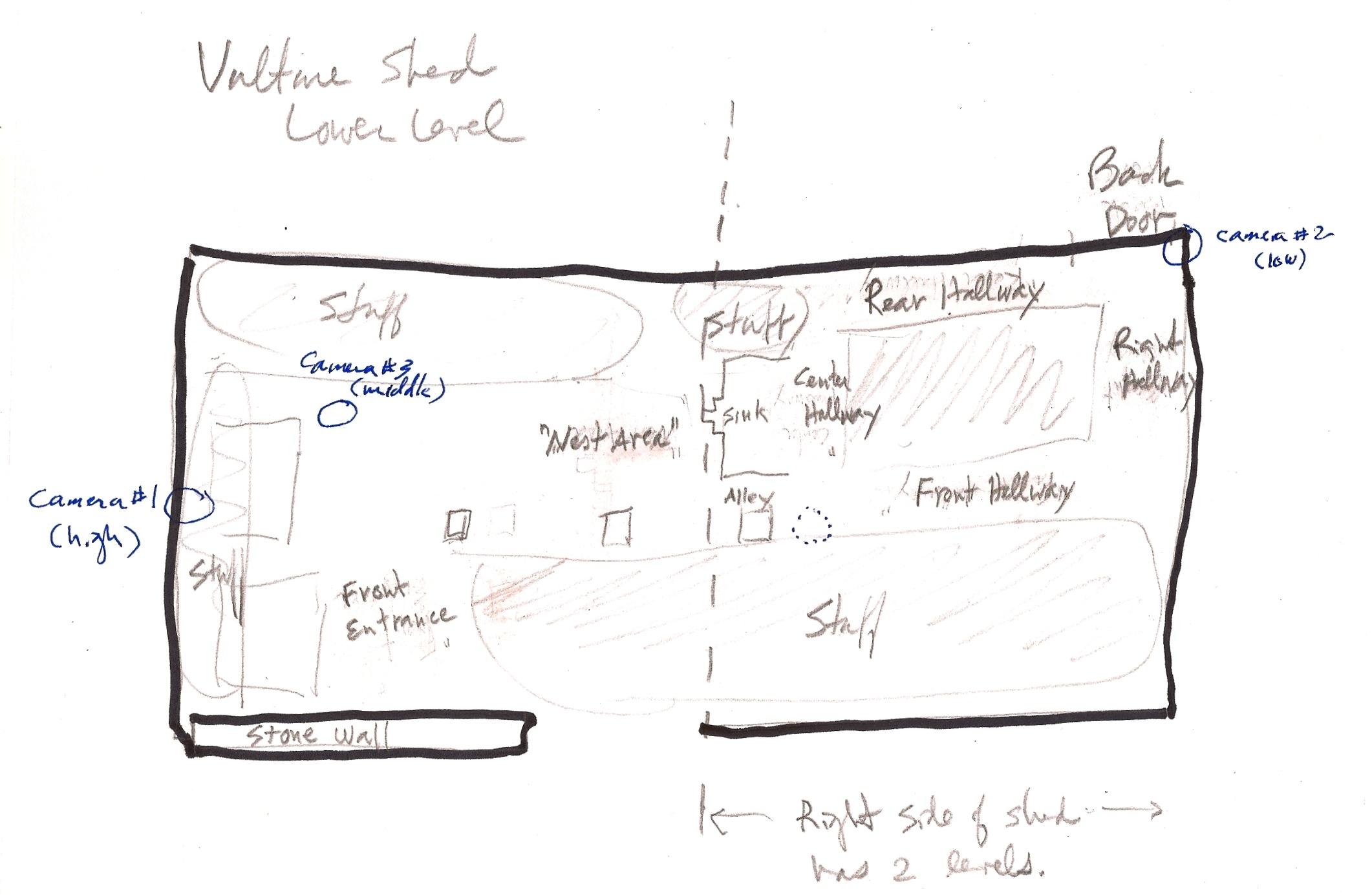
Vulture Shed Layout
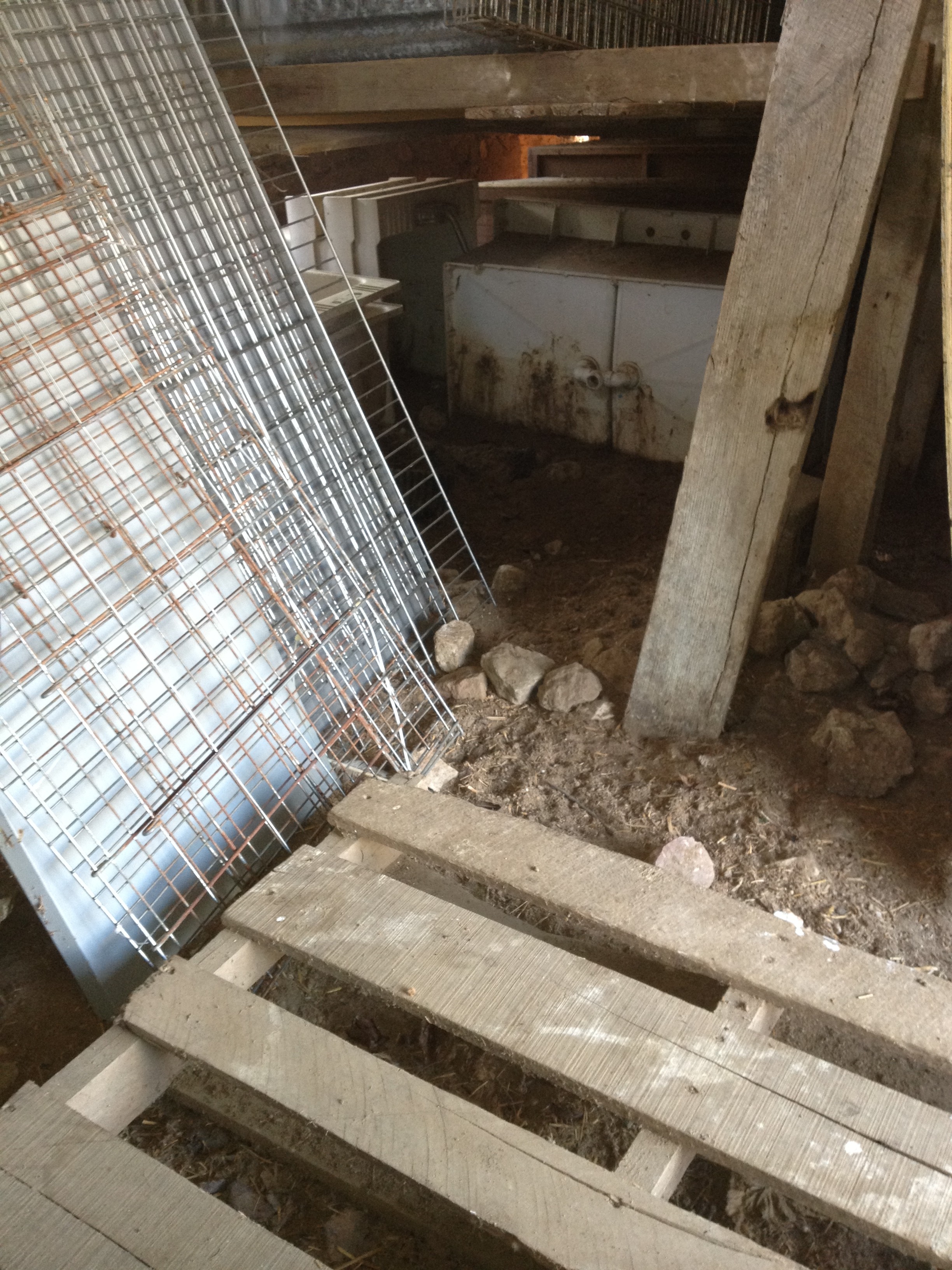
Nest Area Showing Bottom of White Sink
2017 is the sixth season a black vulture pair has used a nest site in a shed monitored by Tri-State Bird Rescue and Research. The first year, 2010, there was only one chick, and it was possible for Tri-State to successfully place a similarly aged but unrelated, orphaned black vulture chick in the nest. In both 2011 and 2012, the adults had two chicks of their own, all of which successfully fledged.
In 2011, the first egg was laid on 3/7/11 with the first chick hatching 39 days later on 4/15/11. Both chicks fledged by 6/30/11, about 2 1/2 months after hatching.
During the 2012 nesting season, two eggs were laid, 2/20/12 and 2/23/12. They both hatched about 39 days later, during a period from 3/31/1 and 4/2/12, with thirty-two hours elapsing from the first visible hole in an egg until the first chick was free of the shell. The second chick was out of the shell about eleven hours later. First flight (25′) was observed 6/14/12, about 2 1/2 months after hatching.
During 2013, a vulture pair began scouting the nest site in January, 2013. Courtship and mating were observed and recorded, and the first egg laid around 7:00 PM on 3/3/13. A second egg was laid at 8:34 AM on 3/6/13. Hatching began 4/11/13, 39 days after the first egg was laid. One of the chicks did not survive the strenuous 30+ hour hatching process. Later, two orphaned chicks were added to the nest. All three chicks were cared for by the adults and successfully fledged. The three chicks, all male, and the adult male were fitted with numbered wing-tags for ongoing identification.
In summary, from the 2010 to the 2013 breeding seasons, 6 chicks hatched and another 3 orphans from other locations fledged for a total of 9 fledglings from this nest site. Vultures did not nest in the shed during the 2014 and 2015 breeding seasons.
In February 2016, the shed again became a black vulture nest site. The pair prepared the “nest” and mated in the shed daily from 2/16/16 to 3/2/16. Neither of the birds were tagged, so it is not the same pair that used the nest in 2013. At 10:13 PM on 3/2/16, the first egg was laid. The second was laid 2 1/2 days later. The first egg began a 26 hour hatching process 39 days later on 4/10/16. The second egg began hatching 33 hours later with the chick taking 19 1/2 hours to complete the process.
Activity at this nest is being recorded 24/7 for research purposes. This appears to be the only American black vulture (Coragyps atratus) nest site from which nesting behavior has been streamed live over the Internet, enabling observations of how adults care for their chicks. Going forward, our research objectives include tracking both the adults and chicks to increase our knowledge of black vulture behavior. Of particular interest is to determine whether the same adult pair use this nest site year after year and to observe interactions between the various generations of vultures associated with this nest. Suggestions for conducting this research and information regarding related research projects/publications would be welcome in the Comments on the Live Feed page of this website.
Below is a summary of nesting activity since 2010:
2010 Nesting Season:
Only one egg laid
Chick hatched successfully
An orphan chick was added to the nest
Both chicks fledged successfully
2011 Nesting Season:
3/7/11 First egg of two
4/15/11 First hatch, both hatched OK
6/30/11 Both fledged successfully
2012 Nesting Season:
2/20/12 First egg laid
2/23/12 Second egg laid
3/31/12 Initial hole appeared in first egg to hatch. (39 days)
4/1/12 One chick out of eggshell (32 hours after initial hole)
4/2/12 Second chick out of eggshell (about 11 hours after the first)
6/14/12 First flight observed (25′) by chick
2013 Nesting Season:
2/11/13 Courting and copulation
3/2/13 Copulation in nest area
3/3/12 First egg laid
3/6/13 Second egg laid
4/11 – 4/13/13 Hatching (Only one chick survived strenuous 30+ hour process.)
5/6/13 Tagged adult male (#17)
5/12/13 Two orphan chicks added to nest
6/13/13 All three chicks tagged (#26, #30, #267)
6/20/13 First flight
2014 & 2015 Nesting Seasons:
No vultures nested in the shed.
2016 Nesting Season:
2/25/16 to 3/2/16 Two adults making nest and mating in shed
3/2/16 10:13 PM First egg laid
3/5/16 9:45 AM Second egg laid (2 1/2 days after the first)
4/10/16 7:15 PM First egg begins to hatch (after 39 days)
4/11/16 9:15 PM First chick totally out of egg (after 26 hours hatching)
4/12/16 4:00 AM Second egg begins to hatch.
4/12/16 11:30 PM Second chick out of shell (after 19 1/2 hours hatching)
6/20/16 Tagged both chicks (#56, #247)
6/30/16 Chicks fledged
2017 Nesting Season:
1/19/17 Untagged vulture pair in tree and on ground around shed.
2/6/17 Vulture pair mated in shed.
2/8/17 Vulture pair in shed mating and hollowing out potential nest areas.
2/21/17 11:28 PM First egg laid.
2/24/17 11:39 AM Second egg laid (about 60 hours after first egg).
4/1/17 4:45 PM First egg begins to hatch (after 39 days)
4/3/17 12:59 AM Second egg begins to hatch (32 hours after first egg)
4/3/17 4:32 AM First chick out of egg shell (after 36 hours hatching)